 Lofoten Islands Tours
Lofoten Northern Lights: When to Come and Where to Stand

The Lofoten northern lights are easier to see than most people expect and harder to plan for than the forecast apps suggest. The archipelago sits deep inside the auroral zone, so the geomagnetic side of the equation is usually satisfied. What decides your trip is cloud, and Lofoten sits in the path of every Atlantic system that comes through. This page covers the season, the spots that actually face the right way, and the honest version of how many nights you need.
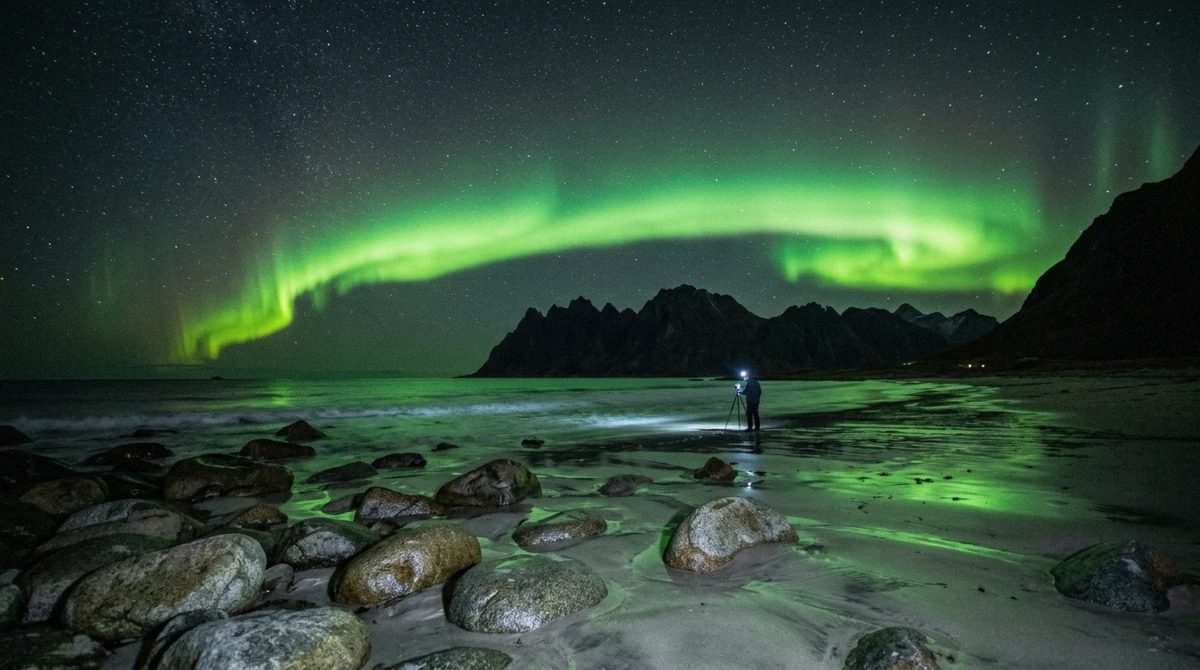
Quick answer
The season runs from late August to mid-April, with the strongest displays between September and March. Lofoten is far enough north that a Kp of 2 to 3 is usually enough, so cloud cover, not solar activity, is what you are actually gambling on. Average cloud during the season sits near 55 percent, which is why three or four nights beat one. You do not need a tour: fifteen minutes out of Svolvær, or any north-facing beach on Vestvågøy, is enough.
Key takeaways
- Best months: September and March, when you get dark nights and still have daylight to use.
- Best hours: roughly 22:00 to 02:00, though a display can start at any dark hour.
- Best spots: Uttakleiv and Haukland on Vestvågøy, Skagsanden near Flakstad, the water in front of Reine.
- Plan three nights minimum. One clear night in three is the realistic assumption in a Lofoten winter.
- Already booked a winter boat? Evening Trollfjord departures put you away from the town lights.
The Season, and the Two Months That Beat the Rest
Late August to mid-April, with a usable core
The aurora is overhead year-round; what changes is whether the sky is dark enough to show it. In Lofoten that means late August to mid-April, and in practice September to March for anything reliable.
The midnight sun runs the other way: from about 25 May to 18 July the sun does not set in Svolvær at all, so there is no aurora season inside that window no matter what the solar forecast says. If you are travelling in June, read the midnight sun page instead and come back another year for the lights.
Why September and March win
December and January give you the deepest darkness, with the polar night in Svolvær running from about 7 December to 5 January. They also give you the worst weather of the year and almost no daylight to do anything else with.
September and March are the better trades. Both have long dark evenings, both sit either side of the wettest months, and both leave you a usable day. In September the mountainsides still have colour and the roads are easy; by late March you are back to twelve hours of daylight with the aurora season still running and snow on the peaks.
February deserves a mention of its own, because the cod fleet is in and the harbours are working. Cold, dark, busy in the right way.
Cloud is the real forecast
Average cloud cover during the aurora season in Lofoten is around 55 percent. That single number explains more about your chances than any Kp reading.
So the discipline is simple: check the cloud map first, the aurora forecast second, and be willing to drive. The archipelago is 130 kilometres end to end and the weather is genuinely local, so a clear patch over Vestvågøy while Svolvær sits under cloud is a normal night here.
yr.no, run by the Norwegian Meteorological Institute, is the forecast locals actually use. Its cloud-cover view by the hour is the tool that matters.
Where to Stand
You want a north horizon and no streetlights
The aurora usually appears as a band across the northern sky before it climbs. So the first requirement is an open view north, and the second is distance from harbour lighting. Lofoten gives you both easily, because the north coast of Vestvågøy is one long beach facing the Norwegian Sea.
From Svolvær, a fifteen-minute walk out of town along the water is enough for a decent display. For the photograph people come for, you want a foreground: a beach, a mountain, a village reflected in still water.
| Spot | From Svolvær | Facing | Why it works |
|---|---|---|---|
| Uttakleiv | About 90 min | North over open sea | Wide beach, boulders in the foreground, the classic Lofoten aurora frame |
| Haukland | About 85 min | North-west | Next bay to Uttakleiv, 25 minutes apart on foot, easier parking |
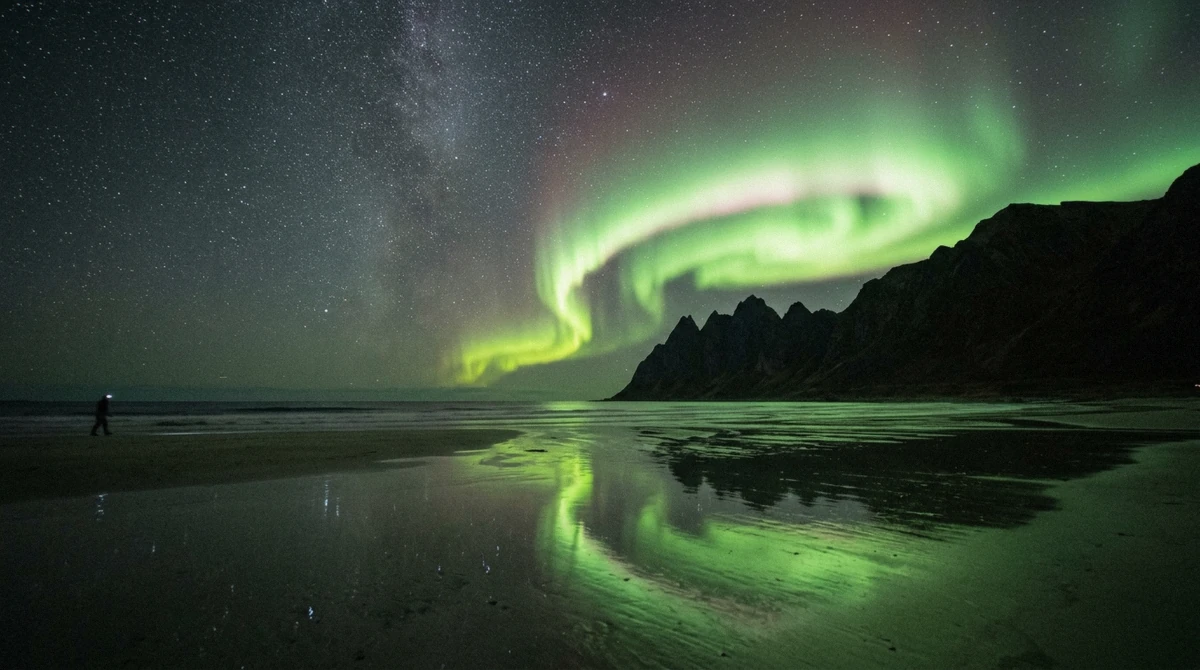
| Skagsanden, Flakstad | About 105 min | North | Flat wet sand that mirrors the sky when the tide is right |
| Reine and Hamnøy | About 2 hours | North-east | Village lights in frame; good when the wind kills the beaches |
| Kabelvåg and Svolvær outskirts | 5 to 15 min | North | The no-car option; enough for seeing, tight for photographing |
Timing your night
Displays cluster between about 22:00 and 02:00, with the hours either side of midnight the most productive. That is not a rule the aurora agreed to, and strong activity can light the sky at 18:00 in December, but it is how to plan.
Check the moon too. A full moon washes out weak displays and lifts the foreground in photographs; a new moon gives you the darkest sky and the most stars. Neither is wrong, but they produce different pictures.
Dress for standing still outdoors for two hours, because that is exactly what you will do. The cold that catches people here is not extreme, it is prolonged, and it arrives through your feet.
Tour or On Your Own
If you have a rental car and three or more nights
Go on your own. Check the cloud map at 20:00, drive to the clear side of the archipelago, and keep the money for something else.
If you have no car and one or two nights
Take a guided chase. What you are buying is a driver who reads the cloud maps and is willing to move 80 kilometres to find a gap.
If you are already booked on a winter boat
Ask about evening departures. A Trollfjord cruise after dark puts you on open water away from town lights, though it is not sold as an aurora tour and nobody will promise you anything.
If you want the photograph more than the sighting
Base yourself on Vestvågøy near Haukland and Uttakleiv, and treat the whole trip as a photography trip. Three nights, tripod, and patience.
If an operator guarantees the aurora
Read the terms. Nobody controls the sky; what good operators offer is a free repeat trip, which is a different and honest promise.
Lofoten or Tromsø
The honest comparison
Both sit under the auroral oval, so on geomagnetic grounds it is a draw. The differences are weather and logistics.
Tromsø is a city with an airport that takes jets, a large fleet of chase operators, and the option of driving inland towards drier air when the coast clouds over. That inland escape is the real advantage, and on a bad-weather week it is decisive.
Lofoten has the foreground. Peaks straight out of the sea, beaches facing north and fishing villages under the display. If you want the photograph that made you plan the trip, this is where it exists. What you give up is the ability to drive two hours to a different climate.
If the aurora is the only reason for the journey and you have three days, Tromsø is the safer bet. If you want a trip that is worth taking whether or not the sky performs, come here.
| Lofoten | Tromsø | |
|---|---|---|
| Aurora zone | Inside it | Inside it |
| Escape from cloud | Limited; the archipelago is narrow | Can drive inland or into Finland |
| Foreground | Peaks, beaches, fishing villages | City, fjord, inland forest |
| Getting there | Bodø plus a hop, or the ferry | Direct jets from Oslo and Europe |
| Chase operators | A handful | Dozens, every night |
| Best for | A trip worth taking either way | Maximising the odds of one sighting |
Camera Settings and What Your Phone Can Do
A phone is enough to see it, not to keep it
Recent phones in night mode will register an aurora your eye reads as a grey band, which is a genuine advantage: the phone often confirms a display before you are sure it is one. Hold it against a wall or a car roof, use the longest exposure night mode offers, and expect a soft result.
What a phone cannot do is hold a foreground and a moving sky at the same time. For that you need a camera you can control on a tripod.
The settings that work here
Start at f/2.8 or as wide as your lens opens, ISO 1600 to 3200, and a shutter between two and eight seconds depending on how fast the display is moving. A slow, curtain-like aurora tolerates eight seconds; a fast one turns to mush past three.
Focus manually on a distant light before dark, then tape the ring. Autofocus will not find infinity in a black sky, and this is where most first attempts fail.
- Tripod, and a wrist strap for it in wind off the sea
- Spare batteries kept warm in an inside pocket; cold halves their life
- Head torch with a red mode so you keep your night vision
- Manual focus set on a distant light before it gets dark
- Boots and two pairs of socks, because you will stand on wet sand
- yr.no cloud forecast checked at 20:00, and a plan B beach
How Many Nights to Book
With cloud cover averaging around 55 percent through the season, a single night is a coin toss with a bias against you. Two nights improves it. Three or four makes a clear window likely, and gives you room to drive to the other end of the archipelago when the forecast splits.
The people who leave disappointed are almost always the ones who came for one night in December, sat under a front for twelve hours and flew home. The people who see it are the ones who stayed a week in September and drove twice.
Our recommendation: build a four-night trip in September or March, base on Vestvågøy or in Svolvær, and treat every clear evening as the night. Book the daytime things loosely, because a good aurora night ends at two in the morning and the next day starts late.
Lofoten Northern Lights Questions
When is the best time to see the northern lights in Lofoten?
The season runs from late August to mid-April, and the reliable core is September to March. September and March are the best months overall: long dark evenings, less of the winter's weather, and enough daylight left to do something with the day. December and January give the deepest darkness, including the polar night from about 7 December to 5 January, but the worst conditions.
Where are the best places to see the northern lights in Lofoten?
Uttakleiv and Haukland on the north coast of Vestvågøy, about 25 minutes apart on foot, are the classic choices because they face open sea to the north. Skagsanden near Flakstad gives you wet sand that mirrors the sky, and Reine puts village lights in the frame. Without a car, walking fifteen minutes out of Svolvær away from the harbour is enough to see a display.
Can you see the northern lights in Lofoten without a tour?
Yes, and most people here do. You need a dark spot with a northern horizon, which the beaches on Vestvågøy provide for free, plus a cloud forecast and the willingness to drive. What a guided chase buys you is a driver who reads the maps and moves when the coast clouds over, which matters if you have no car or only one or two nights.
Is Tromsø or Lofoten better for the northern lights?
Tromsø is the safer bet for sightings, because operators there can drive inland towards drier air when the coast is clouded in. Lofoten is better for photographs, because the peaks, beaches and fishing villages give you a foreground that Tromsø cannot match. If the aurora is your only reason for travelling and you have three days, choose Tromsø; if you want a trip worth taking either way, come here.
How many nights do you need to see the aurora in Lofoten?
Three or four. Average cloud cover during the season is around 55 percent, so a single night is close to a coin toss. Three nights makes a clear window likely and lets you drive to a different part of the archipelago when the forecast splits between east and west.
What Kp index do you need in Lofoten?
Lofoten sits far enough north that a Kp of 2 to 3 is generally enough for a visible display, which is why cloud matters more here than solar activity. On a clear night with Kp 1 you may still see a faint green band low in the north; under thick cloud, Kp 6 gets you nothing.
Can you photograph the aurora on a phone?
A recent phone in night mode will capture a display and often confirms one before your eye is sure. Brace it against a wall or a car roof. For a sharp image with a foreground you need a camera on a tripod at f/2.8, ISO 1600 to 3200 and a two to eight second shutter, with focus set manually before dark.
Do the boat tours run at night in winter?
The Trollfjord boats sail year-round, and winter departures in the dark hours do happen, but they are sold as fjord cruises rather than aurora trips. Being on open water away from town lights is a genuine advantage if the sky performs; nobody schedules the sky. Check the departure times on the tour listings for the dates you are here.