 Lofoten Islands Tours
Things to Do in Lofoten, With What Each One Costs

Most lists of things to do in Lofoten name the same dozen places and stop there. This one keeps the places and adds the parts that decide your day: what each costs in 2026, how far it is from Svolvær or Leknes, and whether it works in February or only in July. The archipelago is 130 kilometres end to end on a single road, so the real skill here is not finding things to do but choosing which direction to drive.
Quick answer
The essentials split three ways. On the water: Trollfjord, which no road reaches, plus sea eagles and summer kayaking. On land: the villages along the E10 from Svolvær west to Å, and the hikes above them. Indoors: the Lofotr Viking Museum at Borg and the stockfish museum at Å for the days the weather closes in. Most of the landscape is free; the museums, the boats and the parking are what you pay for.
Key takeaways
- The one thing you cannot drive to: Trollfjord, reached only by boat from Svolvær, from $108.72.
- The classic drive: Svolvær to Å along the E10, 130 km of villages, or $209.04 guided if you have no car.
- Free and unforgettable: Reinebringen's stone stairs, Haukland and Uttakleiv beaches, the Henningsvær pitch.
- The rain-day answer: the Lofotr Viking Museum at 265 NOK for adults, 170 NOK for children 6 to 15.
- Summer only: midnight sun kayaking at Eggum, which runs from about 25 May to 18 July.
On the Water: the Part You Cannot Drive To
Trollfjord
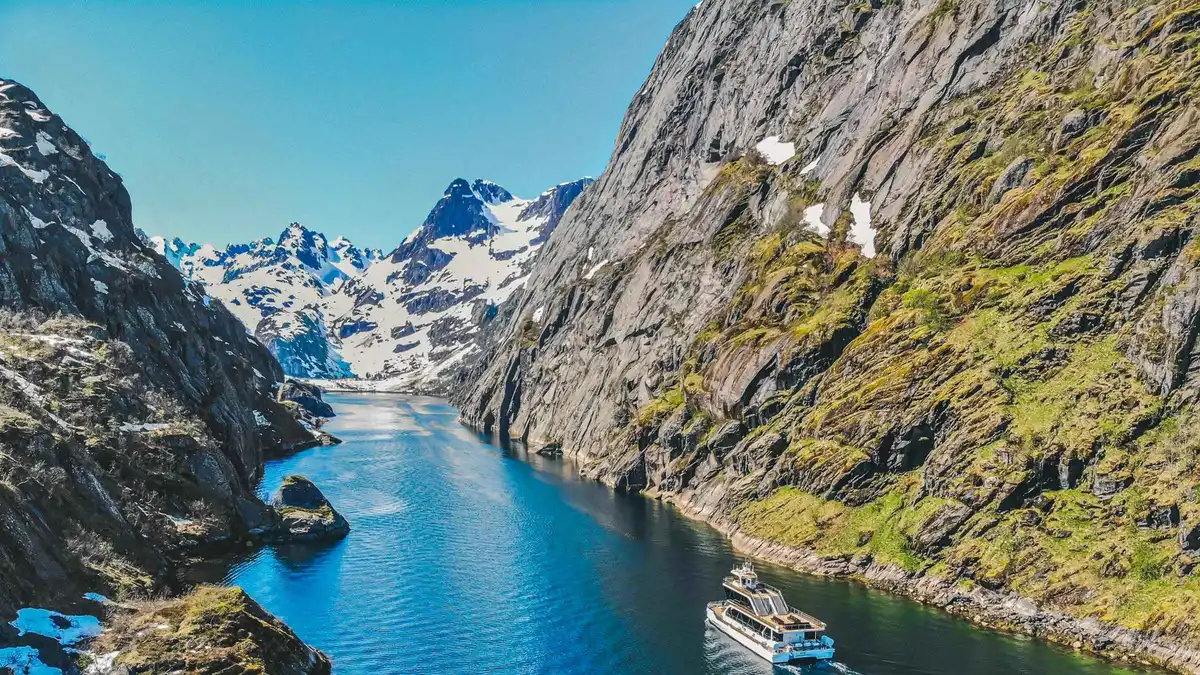
Trollfjord is two kilometres long, its mouth is about 100 metres wide, and no road reaches it. That single fact makes it the one attraction in Lofoten that has to be booked rather than driven to, and it is why four operators sail there daily from Svolvær.
What you get is a slot in the rock with walls 600 to 900 metres high, waterfalls after rain, and a fjord narrow enough that the boat turns around inside it. The cheapest way in is $108.72 on a covered local boat; the full comparison of the four boats is on its own page.
Sea eagles in Raftsundet
The strait on the way to Trollfjord holds one of Europe's densest white-tailed eagle populations. The bird has a wingspan up to 2.65 metres, the largest of any raptor in northern Europe, and on the RIB safaris the crew throws fish and the birds come in low over an open boat.
It is the most reliable wildlife encounter in Lofoten and it takes two hours. Whales are a Vesterålen and Tromsø proposition rather than a Lofoten one; do not come here expecting them.
Kayaking, and the midnight sun version
Sea kayaking works all summer in the sheltered water around the islands, but the trip worth building a night around launches at Eggum on the northwest coast of Vestvågøy, facing open Atlantic. Three hours, beginner-friendly, and timed so the sun drops to the horizon and climbs back out of it while you are on the water.
It only exists between about 25 May and 18 July, when the sun does not set in Svolvær. Outside that window nothing replaces it.
Fishing, which is the reason all of this is here
Lofoten is a fishing archipelago that happens to be beautiful. From late January into April the skrei arrive from the Barents Sea to spawn and the Lofotfisket season fills the harbours; the 2026 Barents Sea quota was cut 16 percent to 285,000 tonnes, so the fleet is smaller than it was, but the racks still go up.
Operators in Svolvær, Henningsvær and Ballstad run sea-fishing trips year-round, and in winter you can watch the working side of it from any harbour wall for nothing.
Tours Worth Booking Before You Arrive
Summer departures fill, and the midnight-sun kayak has a nine-week season. Everything here cancels free up to 24 hours ahead.
 from $156.36
Most reviewed — 3,503
from $156.36
Most reviewed — 3,503
Silent Trollfjord Cruise from Svolvær by Hybrid-Electric Catamaran
Brim Explorer's purpose-built catamaran runs on battery inside the fjord, so the engine noise stops and you hear the water off the walls. Three and a half hours, heated saloon, outdoor decks, and the only Lofoten boat with an underwater drone feed.
Check Availability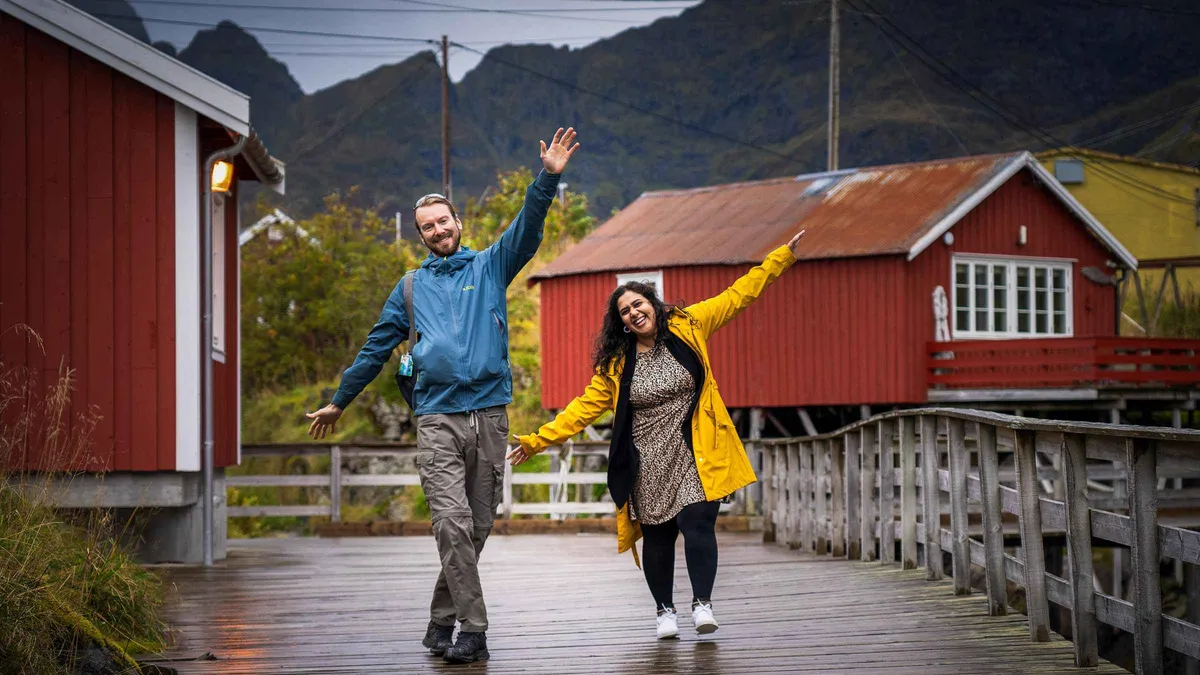 from $209.04
Only full-day tour
from $209.04
Only full-day tour
Full-Day Lofoten Road Trip: Reine, Hamnøy, Sakrisøy & Å
Nine hours down the E10 in a small minivan from Svolvær or Leknes, with a local guide on headsets and stops at the four villages every photographer comes for. The one tour here that gets you to the far end of the archipelago without a rental car.
Read the full guide → Check Availability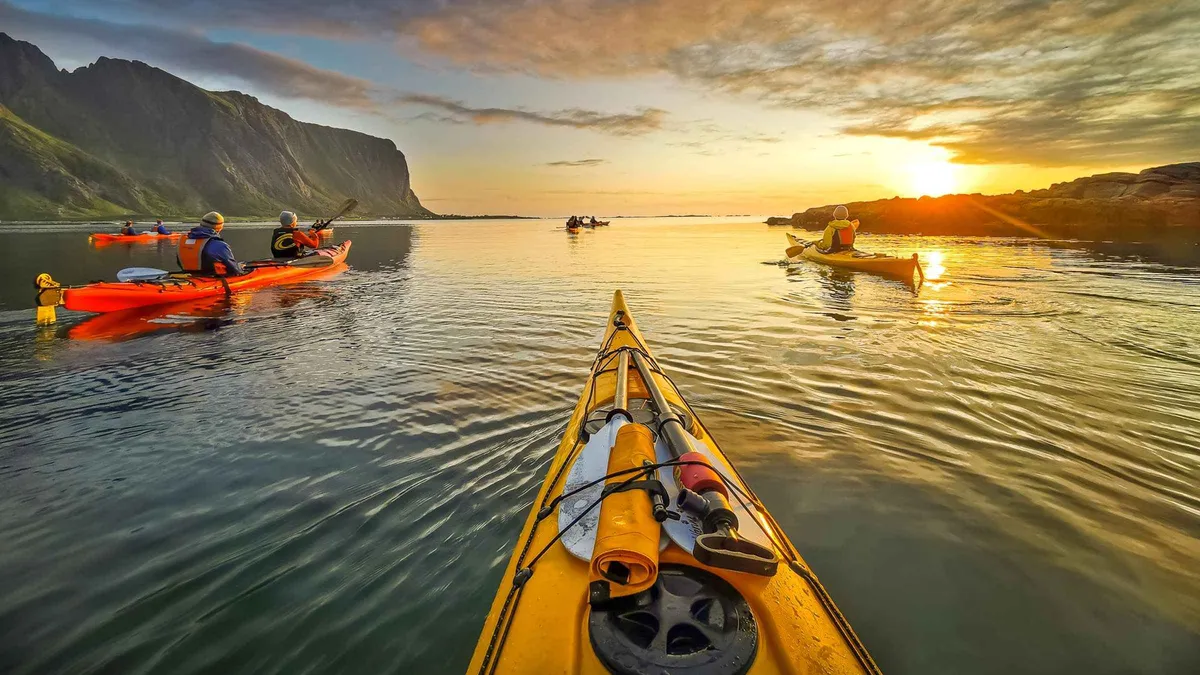 from $115.43
Summer only — 25 May to 18 July
from $115.43
Summer only — 25 May to 18 July
Midnight Sun Sea Kayaking at Eggum, Vestvågøy
Three hours on open Atlantic water on Vestvågøy's northwest coast, timed so the sun drops to the horizon and climbs again while you are on it. Rated 4.9 across 406 reviews, and the only tour on this page that cannot run outside the midnight-sun window.
Check Availability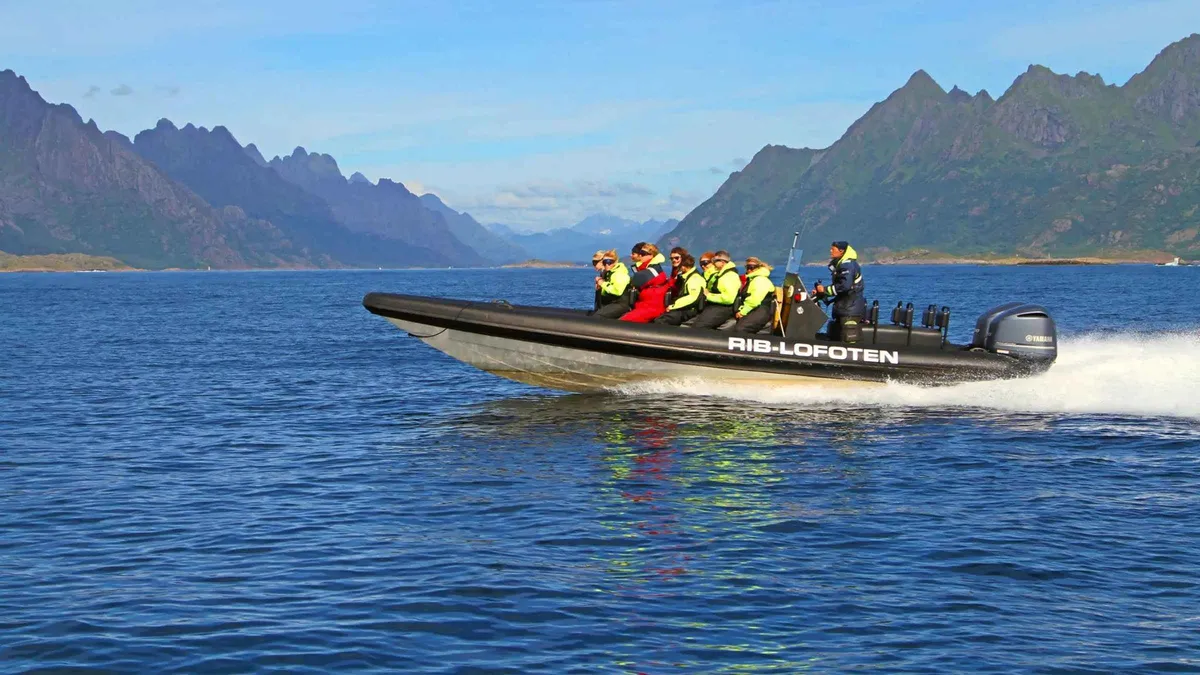 from $125.40
Fastest way in — 2 hours
from $125.40
Fastest way in — 2 hours
Two-Hour RIB Sea Eagle Safari to Trollfjord
A rigid inflatable that covers Raftsundet at speed, with flotation suits handed out on the quay in Svolvær. You sit outside the whole way, which is the point: the eagles come in low over an open boat.
Check Availability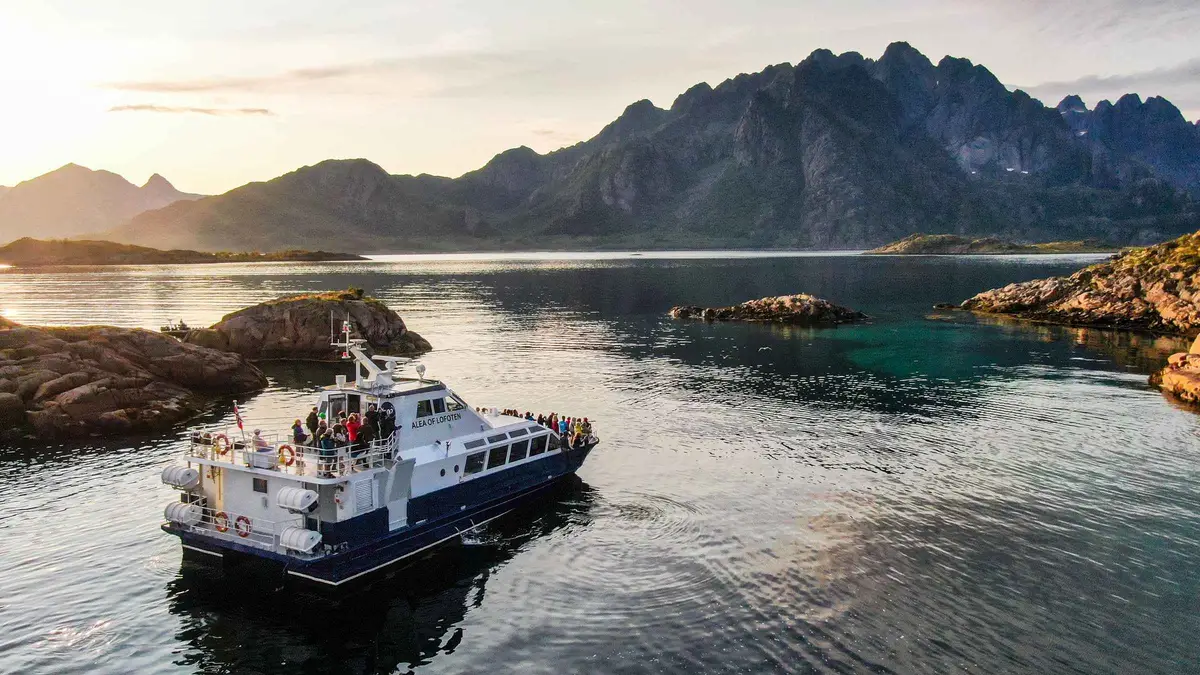 from $108.72
Cheapest Trollfjord trip
from $108.72
Cheapest Trollfjord trip
Trollfjord Cruise & Sea Eagle Safari with a Lofoten Family Operator
Go2Lofoten is a local family business running a covered boat, three hours out of Svolvær, with the area's history told on the way. The lowest price on this page and the calmest ride of the Trollfjord group.
Check Availability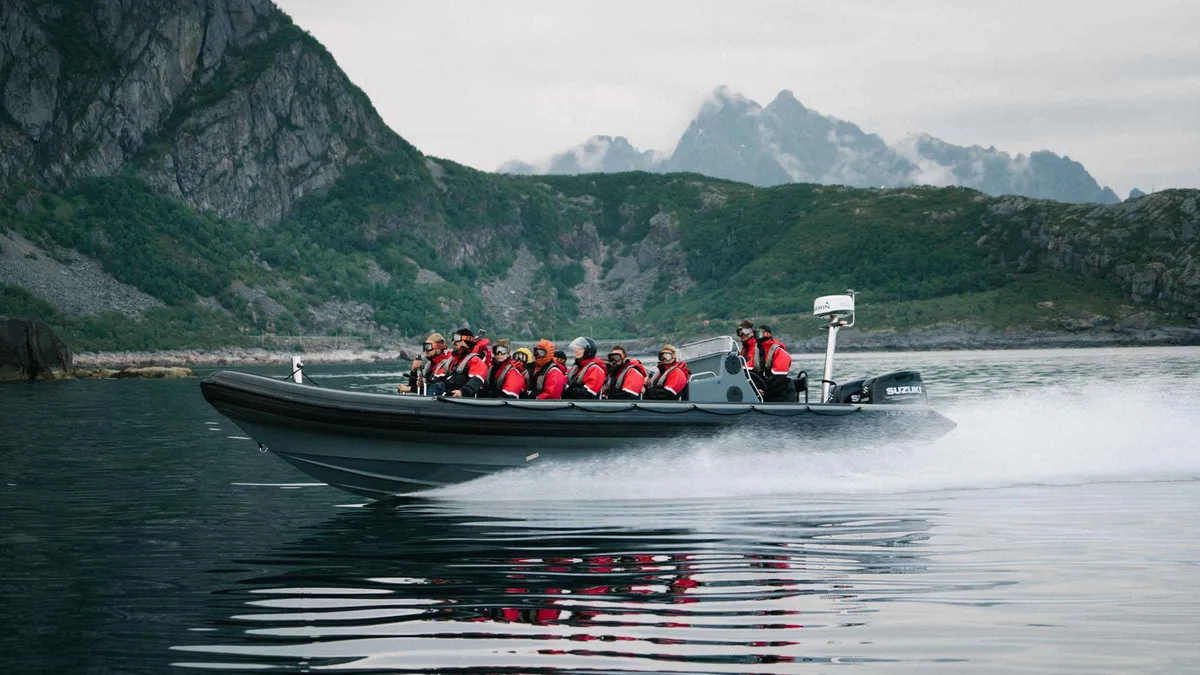 from $125.40
Highest rated RIB — 4.9
from $125.40
Highest rated RIB — 4.9
RIB Trollfjord & Sea Eagle Safari, Rated 4.9
The same two-hour RIB run into Trollfjorden, with the strongest rating of the fast boats across 887 reviews. Steep walls, beaches on the way out, and enough speed that the fjord arrives before you are cold.
Check AvailabilityThe Villages, East to West
Svolvær and Kabelvåg
Svolvær is the largest town, the transport hub and the departure point for every boat tour on this site. Above it stands Svolværgeita, the two-horned rock spire that climbers jump between at the summit, visible from the harbour.
Kabelvåg, five kilometres west, is older and quieter, with a wooden church that seats more people than the village holds. Both are walkable, both have places to eat in winter, which is not true everywhere here.
Henningsvær
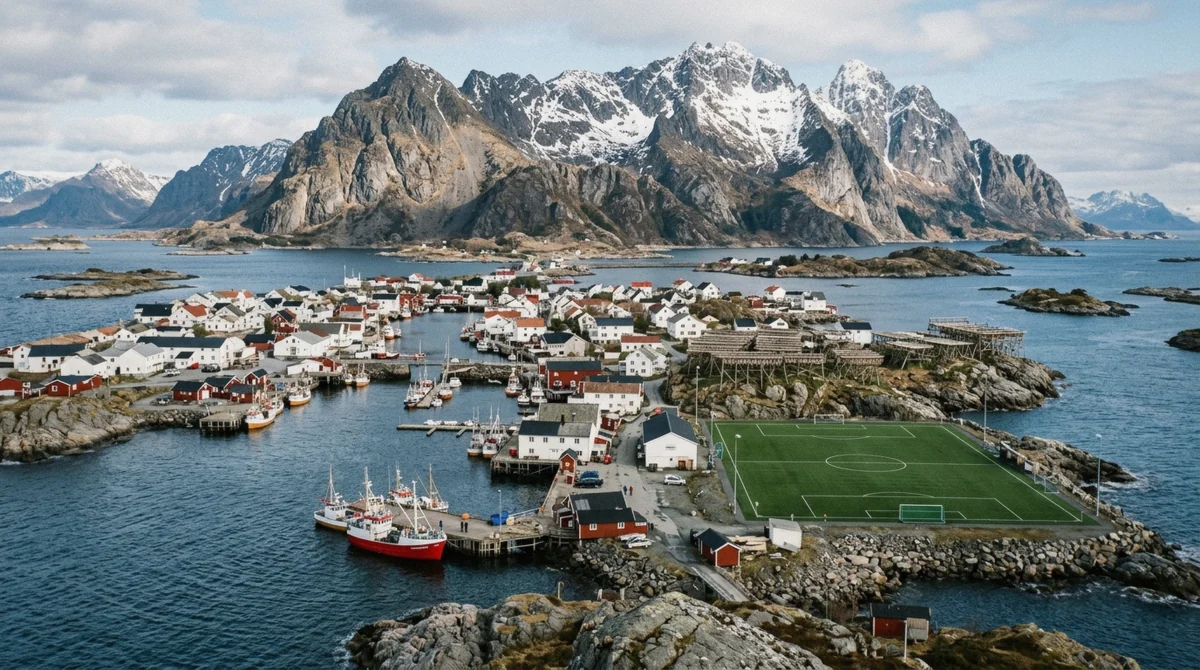
Twenty-five kilometres from Svolvær, out along a chain of bridges onto small islands. Henningsvær is a working harbour that also holds galleries, a couple of good cafés and the football pitch surrounded by drying racks that appears in every Lofoten photo set.
It is the easiest half-day out of Svolvær with or without a car, and the one village that stays busy year-round.
Nusfjord
A restored fishing village on the south coast of Flakstadøya, one of the oldest and best preserved in Norway, run partly as an open-air museum. In high season the centre charges an entry fee, which surprises people who assumed it was just a village.
It is a detour off the E10 rather than a stop on it, and worth it in shoulder season when you have the boardwalks to yourself.
Reine, Hamnøy, Sakrisøy and Å
The western cluster is what most people come for. Hamnøy has the bridge everyone photographs, Sakrisøy the yellow rorbuer, Reine sits under the Reinebringen ridge, and Å is where the E10 stops at a stockfish museum, a bakery in an old boathouse and racks of drying cod.
From Leknes it is 60 kilometres and about an hour ten of driving, which becomes two hours in summer traffic. From Svolvær it is roughly 130 kilometres, so plan a full day. Without a car the nine-hour guided run at $209.04 covers all four with a guide on headsets.
Svolvær to Å Along the E10
One road, 130 kilometres, and the stops in the order you meet them driving west.
- Boat quay, airport, Svolværgeita overhead. Every fjord tour leaves from here.
- The older neighbour, wooden church, quiet harbour. Ten minutes from Svolvær.
- Off the E10 on a chain of bridges. Galleries, cafés and the famous pitch.
- The Lofotr Viking Museum and its 83-metre reconstructed longhouse. 265 NOK for adults.
- Airport, supermarkets and the turn-off north to Haukland and Uttakleiv beaches.
- Restored fishing village on a side road, entry fee in high season.
- The postcard cluster, Reinebringen above, ferry terminal at Moskenes nearby.
- End of the road. Stockfish museum, bakery, drying racks.
Hikes and Beaches
Reinebringen, the one you have seen
The view over Reine from the ridge above it is the most photographed thing in northern Norway, and reaching it means a Sherpa-built stone staircase of roughly 1,500 to 2,000 steps climbing straight up from the E10. It is free, it takes most people an hour up, and it is relentless.
It is also genuinely dangerous in the wrong conditions. Autumn storms, cold rain and wet snow turn the stone slick, and the trail closes at times for maintenance. Check current status locally before you set out, and turn back if the weather comes in.
Ryten and Kvalvika
Kvalvika is the beach with no road: a 45-minute walk in over a saddle from the Fredvang side, and worth every minute of it. Ryten, the summit above, adds the view down onto the sand that turns up on posters.
Do both in one outing and budget three to four hours. Boots, not trainers, and the ground stays wet long after the rain stops.
Haukland, Uttakleiv and Unstad
Haukland and Uttakleiv sit on the north coast of Vestvågøy about 25 minutes apart on foot over the headland, and they are white-sand beaches on water that looks tropical until you put a hand in it. Both have parking, which is paid in season.
Unstad, further north, is the surf beach: a left point break, a reef break, board and wetsuit rental and a café that has become a destination in itself. People surf there through the winter, in the dark, which tells you most of what you need to know about Lofoten.
- Reinebringen: about 1 hour up, roughly 1,500 to 2,000 stone steps, free
- Ryten and Kvalvika: 3 to 4 hours round trip, 45-minute walk in to the beach
- Haukland to Uttakleiv: 25 minutes on foot over the headland, paid parking in season
- Unstad: surf beach with rental and a café, surfed year-round
- Svolværgeita: a climbing objective, not a hike; look at it from the harbour
Museums, Rain Days and Culture
The Lofotr Viking Museum at Borg
In the 1980s a farmer's plough turned up the largest Viking-age building ever found. The museum at Borg rebuilt it: an 83-metre chieftain's longhouse, with a ship, a smithy and the reconstructed interior.
High-season tickets are 265 NOK for adults and 170 NOK for children aged 6 to 15, with lower off-season rates. It is the single best indoor hour in Lofoten and it is about 70 kilometres from Svolvær, near Leknes.
Å, and what stockfish actually is
At the end of the E10, Å keeps a stockfish museum in the old commercial buildings and a bakery still working out of a boathouse. The drying racks around it are not a display: unsalted cod hung on wood in cold air is what Lofoten exported for a thousand years, and it is still the reason Italy knows this archipelago's name.
It is a small place and half an hour covers it, but combined with the drive west it makes the day.
When it rains, and it will
Lofoten weather turns fast and comes in from the Atlantic. The rain-day list is short and honest: the Viking museum, the Å museums, the galleries in Henningsvær, the Magic Ice bar in Svolvær, a long lunch.
The better answer is often to go out anyway on a covered boat. Rain alone does not cancel a Trollfjord cruise, the saloon is heated, and the walls look better wet.
Northern Lights, and How to Actually See Them
The season, and what it depends on
Lofoten sits inside the auroral zone, so the limiting factor is darkness and cloud rather than latitude. The season runs from roughly September to early April, with the deepest darkness during the polar night from about 7 December to 5 January.
September and March are the sweet spots. Both give you long dark evenings, a decent chance of clear sky between Atlantic systems, and enough daylight left over to have done something with your day. Midwinter has the darkness but also the worst of the weather.
Activity forecasts matter less than the cloud forecast. A modest aurora under a clear sky beats a strong one behind a front, and here the front is usually what you get.
Where to stand
You do not need a tour. Walk fifteen minutes out of Svolvær away from the harbour lights, or drive to any of the beaches on the north side of Vestvågøy, and you have a horizon and no light pollution. Uttakleiv and Haukland are the favourites because the aurora sits over open sea to the north with mountains framing it.
What a guided trip buys you is a driver who watches the cloud maps and moves, which in an unsettled week is worth real money. What it cannot buy is a guarantee, and any operator promising one is selling something else.
Dress as if you will stand still outdoors for two hours, because that is exactly what you will do. The cold that gets people here is not extreme, it is prolonged.
Driving, Parking and the Practical Realities
The road is the attraction, and the bottleneck
The E10 is a single road with one lane each way for most of its length, threading tunnels and bridges between villages. In July it carries campervans, rental cars and coaches at the pace of the slowest of them, which is why 60 kilometres from Leknes to Reine takes two hours rather than one.
Drive early or late. Between 07:00 and 09:00 the road is yours, and in summer 21:00 to 23:00 gives you the same emptiness with better light. The middle of the day is when every car park in the west is full.
Winter driving is a different skill. Studded tyres are standard on rentals from November, the wind on exposed bridges is real, and a storm can close a stretch for hours. Check the road status before committing to a long drive.
Parking costs money now
The pressure of visitor numbers has ended free parking at the popular stops. The beach car parks on Vestvågøy charge in season, Reine and Hamnøy have paid parking, and the Reinebringen trailhead fills before nine on a July morning.
Most machines take cards or app payment, and fines are enforced. Roadside parking on the E10 verges is not a legal workaround and, at the photo spots, is genuinely dangerous.
The honest version: if you are visiting the western villages in peak season without a plan for where to leave the car, you will spend a chunk of your day driving in circles. Arriving before 09:00 solves it.
Fuel, food and opening hours
Petrol stations thin out west of Leknes, so fill up before you commit to the run to Å. Supermarkets close early by European standards and many close entirely on Sunday; in winter, small village cafés shut for the season without much notice.
Svolvær, Leknes and Henningsvær are the reliable places to eat year-round. Everything else is seasonal, and the further west you go the more that matters.
What Is On, Month by Month
Same archipelago, twelve different versions of it. The boats run all year; everything else has a season.
- JanuarySun returns, aurora at its bestThe sun comes back to Svolvær around 5 January. Dark, cold and the strongest northern-lights odds of the year.
- FebruaryLofotfisket and the fleetSkrei arrive from the Barents Sea, harbours fill with boats and the drying racks go up. Six hours of daylight.
- MarchLight and aurora togetherTwelve hours of daylight by month's end with the aurora season still running. The best all-round winter week.
- AprilQuiet shoulderCod season winds down, crowds have not arrived, prices are low and the weather is unsettled.
- MayGreen returns, midnight sun beginsRoads clear, villages wake up, and the sun stops setting around 25 May.
- JuneRound-the-clock daylightKayak tours at 22:00 finish in full light. Hiking conditions improve through the month.
- JulyPeak everythingFerry queues, full car parks at Reine, and the last midnight sun around 18 July.
- AugustWarmest water, first dark nightsBest hiking conditions of the year, and darkness starts returning at the end of the month.
- SeptemberAurora season opensAutumn colour on the mountainsides, dark enough for northern lights, far fewer visitors.
- OctoberStorms arriveWet and windy. Boat cancellations pick up, so keep a spare day in the plan.
- NovemberCheapest monthA few hours of blue light at midday, empty roads, lowest accommodation prices of the year.
- DecemberPolar nightThe sun stays down from about 7 December to 5 January. Long blue twilight rather than total darkness.
Where to Base Yourself, and What It Changes
Svolvær and the east
Basing in Svolvær means you walk to the boats, the shops and the bus, and you can arrive by air or express boat without a car. It is the pragmatic choice for a short trip and the only one that really works in deep winter, when the restaurants and hotels stay open and the western villages half-close.
The cost is distance. Reine is 120 kilometres west, which in summer traffic is a two-and-a-half-hour drive each way, so the postcard villages become a full-day expedition rather than an evening stroll.
Leknes, Ballstad and the middle
The middle of the archipelago splits the difference: an hour from Svolvær, an hour from Reine, with the Vestvågøy beaches and the Viking museum on your doorstep. Leknes itself is a service town rather than a scenic one, so most people stay in Ballstad or one of the farms nearby.
This is the base for anyone who wants beaches and hikes more than harbours, and it is where you find the largest supply of self-catering cabins.
Reine, Hamnøy and the west
Staying west puts you inside the landscape everyone photographs, with Reinebringen above and the ferry terminal at Moskenes ten minutes away. Wake up early and you have Hamnøy bridge to yourself; the day-trippers do not arrive until eleven.
What you give up is choice. There are few restaurants, prices in July are the highest in Lofoten, and any Svolvær-based tour means two hours of driving before it starts. If a Trollfjord cruise matters to you, book it for an arrival or departure day when you are passing through the east anyway.
Rorbuer, and whether they are worth it
The red cabins on stilts are the classic Lofoten stay, and most are converted fishermen's quarters rather than replicas. They are comfortable, they nearly always have a kitchen, and the good ones sit directly over the water.
Prices swing harder by season than by standard. The same cabin in Reine costs a multiple in July of what it costs in November, which is the strongest argument for a shoulder-season trip. Book six months out for summer; a fortnight is usually enough in the dark months.
Note for 2027 planning: Norway's visitor levy took effect on 1 July 2026, and the Lofoten municipalities aim to start collecting on 1 January 2027, at up to 3 percent on paid accommodation. Nothing is added to a 2026 booking, and tours are not covered by it at all.
Winter Lofoten and Summer Lofoten Are Different Trips
Summer, roughly May to August
Everything is open, the light never stops between 25 May and 18 July, and you can hike, kayak and drive at eleven at night. It is also the crowded version: ferry queues, full car parks at Reine, and accommodation booked months ahead.
If you come in July, book the ferry crossing and the tours before you book anything flexible, and start your driving days early. The light means you can shift a village visit to 21:00 and have it almost to yourself.
Winter, roughly November to March
Snow to the waterline, aurora on clear nights, the cod fleet in February and March, and prices at their lowest. The boats still sail, including through the polar night from about 7 December to 5 January.
What you give up is daylight and flexibility. Hikes like Reinebringen become genuinely hazardous, some cafés and small museums close for the season, and a storm can shut a road or ground a flight. Winter here rewards people who plan two options a day and are relaxed about which one happens.
What you can do without a car
More than people assume. Svolvær works entirely on foot: the boat quay, the shops, the hotels and the bus stop are within a few minutes of each other, and every fjord tour leaves from the harbour.
Bus 300 covers the E10 twice a day in each direction if your timings are flexible, and the guided day tour to Å solves the western villages in one go for $209.04. What is hard car-free is the beaches and trailheads, which sit off the main road with no service.
Where these places are
One road ties the archipelago together. Distances are from Svolvær unless stated.
- Svolvær Tour quay, airport, Svolværgeita
- Henningsvær 25 km, harbour village and the football pitch
- Borg Lofotr Viking Museum, 83-metre longhouse
- Haukland Beach North coast of Vestvågøy, 25 min walk to Uttakleiv
- Unstad Surf beach with rental and café
- Reine Reinebringen stairs above the village
- Å i Lofoten End of the E10, stockfish museum
- Trollfjord Boat access only, from Svolvær
Things to Do in Lofoten: Common Questions
What are the best things to do in Lofoten?
A boat into Trollfjord, because no road goes there; the drive or guided day west through Reine, Hamnøy and Sakrisøy to Å; the stone stairs up Reinebringen; Haukland and Uttakleiv beaches; and the Lofotr Viking Museum at Borg for the one indoor hour that is genuinely worth the ticket.
What is there to do in Lofoten in winter?
Northern lights from September to early April, the Lofotfisket cod season in February and March with the fleet in every harbour, and Trollfjord cruises that run right through the polar night. Snow reaches the waterline, prices drop, and the villages are at their quietest. Hikes are the thing to be careful with.
What is there to do in Lofoten in summer?
Everything, plus daylight around the clock from about 25 May to 18 July. Midnight-sun kayaking at Eggum, hiking Ryten and Kvalvika, the beaches on Vestvågøy, surfing at Unstad, and village evenings at 22:00 when the day-trippers have gone.
Are the Lofoten Islands worth visiting?
Yes, if the appeal is landscape and working coastal villages rather than sunshine or nightlife. Nowhere else in Europe puts 900-metre peaks directly into the sea with fishing settlements underneath them at this latitude. Come for the weather too, not despite it, because you will get plenty of it.
How many days do you need in Lofoten?
Two full days for Svolvær, one boat tour and Henningsvær with a weather buffer. Four days to add the drive west without rushing. Three is the common compromise and works if you stay east and take one guided day west rather than driving it yourself.
What is the most beautiful village in Lofoten?
Reine takes the vote in most polls, though the photograph everyone means is taken from the bridge at Hamnøy looking back at it. Nusfjord is the better preserved historically, Henningsvær the most alive year-round, and Å the most complete as a picture of what the cod trade actually was.
Can you see the northern lights in Lofoten?
From roughly September to early April, on clear nights, yes. Lofoten sits inside the auroral zone and the winter darkness runs deep, with the polar night from about 7 December to 5 January. You need a clear sky more than you need a tour; get away from harbour lights and look north.
Is there anything to do in Lofoten when it rains?
The Lofotr Viking Museum at Borg, the stockfish museum at Å, the galleries in Henningsvær and the ice bar in Svolvær. Better still, take a covered boat out anyway: rain does not cancel a Trollfjord cruise, the saloon is heated, and the fjord walls look better wet.
What can you do in Lofoten without a car?
Svolvær on foot covers the boat tours, the harbour and the restaurants. Bus 300 runs the E10 twice a day each way, and the nine-hour guided tour reaches Reine, Hamnøy, Sakrisøy and Å for $209.04. Trailheads and beaches are the awkward part without wheels.
Do you have to pay to visit Nusfjord or Reinebringen?
Reinebringen is free; the stone staircase is public and you pay nothing to climb it, though parking below fills fast. Nusfjord charges an entry fee to the historic centre in high season, since the village operates partly as an open-air museum. Beach car parks on Vestvågøy also charge in season.
Do you have to pay for parking in Lofoten?
At the popular stops, yes. The beach car parks on Vestvågøy charge in season, Reine and Hamnøy have paid parking, and the Reinebringen trailhead fills before nine on a summer morning. Machines take cards or app payment and fines are enforced. Parking on the E10 verge is neither legal nor safe at the photo spots.
What is there to do in Lofoten with kids?
The Lofotr Viking Museum at Borg is built for it, with the longhouse, the ship and costumed staff. Beyond that: the beaches at Haukland and Uttakleiv, the harbour and pitch at Henningsvær, and a covered boat to Trollfjord rather than a RIB, since it has indoor seating and a toilet. Check the minimum age on any RIB listing before booking.
Is Lofoten crowded?
In July, at the western villages, between ten and four, yes. Car parks fill, the Hamnøy bridge has a queue for the photograph and the Moskenes ferry leaves cars behind. Everywhere else and every other month it is quiet. Driving before nine or after nine in the evening removes most of the problem.
Can you swim in Lofoten?
People do, at Haukland, Uttakleiv and Unstad, mostly in August when the sea is at its warmest, and mostly briefly. The water sits in single digits Celsius year-round. Surfers at Unstad wear full winter wetsuits with hoods and gloves, which tells you what an unprotected swim feels like.